The British saw all their colonies as sources of raw materials (cotton from India; sugar from the West Indies; furs, indigo and wood from the Americas) to be shipped to England and turned into finished products in British factories. Thus, when American colonists began boycotting British goods in response to the Intolerable Acts of the 1760s, American women showed their patriotism by making their own fabrics. “Homespun” became an act of resistance.
Out of necessity, the homespun clothing of the period was plain (ribbons, lace and fine fabrics could not be imported) and crafted so that each finished piece could be taken apart and restitched when fashions changed or when an elbow or knee wore out. Dressing to show one’s status, as was common in Europe, became distinctly out-of-favor in the colonies. In 1769, the Virginia Gazette noted with admiration that over 100 women at a recent Richmond ball had worn homespun gowns.
John Adams wrote that “Silks and Velvets and Lace must be dispensed with [as] Trifles in a Contest for Liberty.” The Continental Association of 1774 declared that wool was the best republican material; after all, it was practical, non-fussy, and sheep were abundant. That gave rise to spinning bees, where colonial women would gather to socialize while spinning wool into yarn, often competing to see who could produce the most.
“Linsey-woolsey” was another common and important fabric in the colonies, involving the tedious and tremendously time-consuming process of turning flax into threads that could be woven with wool to produce a sturdy and plain all-American length of cloth.
Even after the war ended, people continued wearing homespun as a show of republican simplicity. In fact, George Washington pointedly wore a homespun suit for his first inauguration… made with wool from a Connecticut mill. He asked a friend “to procure me homespun broad cloth, of the Hartford fabric, to make a suit of cloaths for myself. I hope it will not be a great while, before it will be unfashionable for a gentleman to appear in any other dress. Indeed we have already been to long subject to British prejudices.”
Sources:
DirtyBlueShirts.com
“The Hands that Spun the Revolution,” by Jennifer Gonzalez
Fashion Archives and Museum of Shippensburg University
The White House Historical Association
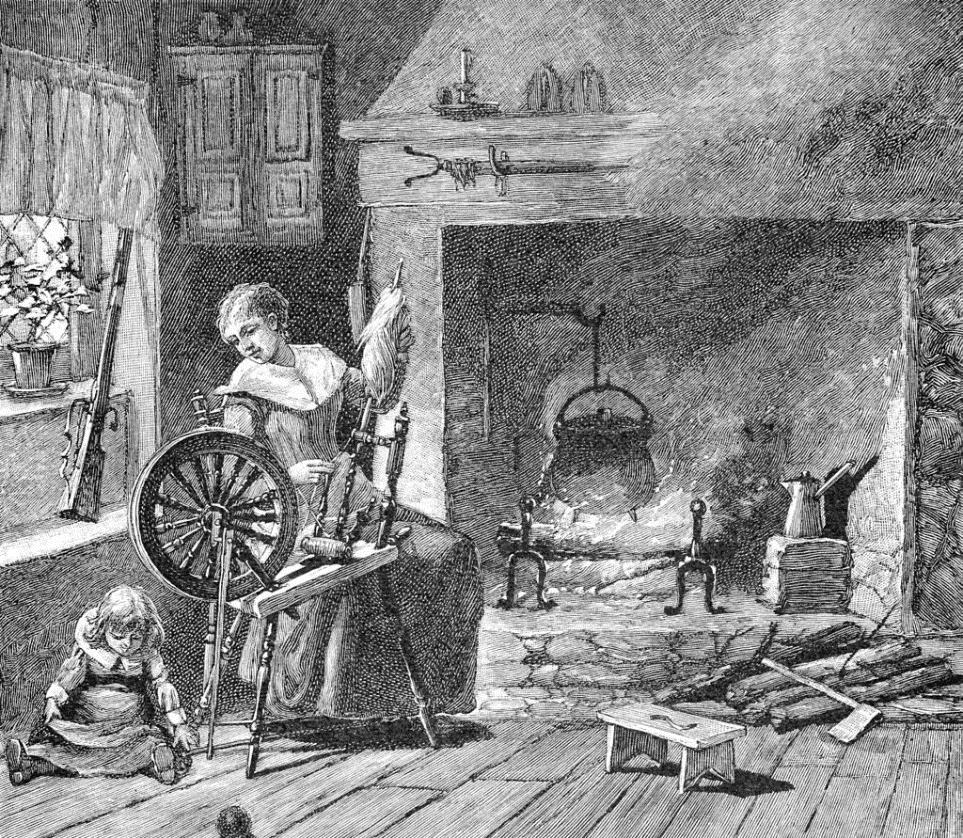
Engraving in A Brief History of the United States. 1885. Joel Dorman Steele.
 Black Rock Community Council History Program